

Most people applying for a home loan in Malaysia think the property is what gets assessed. It is not — not first, anyway.
Before a bank looks at the house, it looks at you. Specifically, it works out how much of your monthly income is already committed to other debts. That figure is your Debt Service Ratio, and it decides more home loan applications than any other single number.
The useful thing about DSR is that you can calculate it yourself, in about ten minutes, before you approach anyone. Here is how.
What DSR Actually Measures
Debt Service Ratio is the share of your monthly income already going towards debt repayments. Banks use it to answer one question: if we lend you this money, can you realistically afford the repayments alongside everything else you are already paying?
The formula is straightforward:

The result is a percentage. The lower it is, the more comfortable the bank feels. Crucially, the calculation includes the new home loan instalment you are applying for — banks assess your position after the loan, not before it.
A Worked Example
Take a salaried applicant earning RM6,500 net per month, with the following existing commitments:
| Commitment | Monthly amount |
|---|---|
| Car loan instalment | RM850 |
| PTPTN repayment | RM300 |
| Credit card (5% of a RM20,000 limit) | RM1,000 |
| Total existing commitments | RM2,150 |
Before any home loan, the DSR is RM2,150 ÷ RM6,500 = 33.1%. Comfortable.
Now add the home loan being applied for. Say the instalment works out at RM1,900 a month:
| Calculation | Figure |
|---|---|
| Existing commitments | RM2,150 |
| New home loan instalment | RM1,900 |
| Total monthly commitments | RM4,050 |
| Net monthly income | RM6,500 |
| DSR after the new loan | 62.3% |
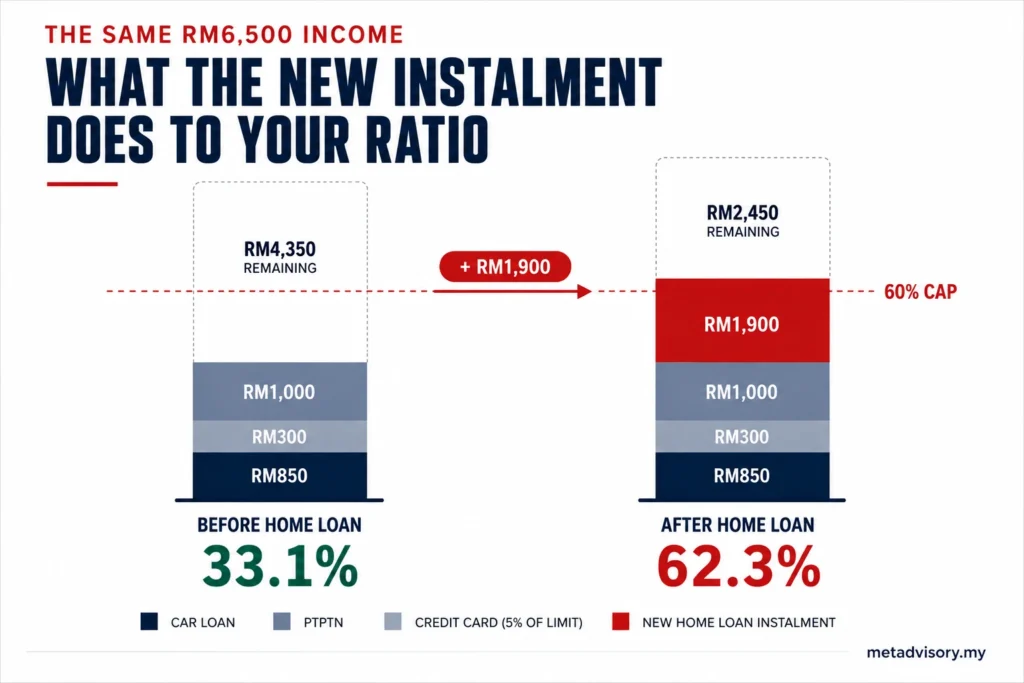
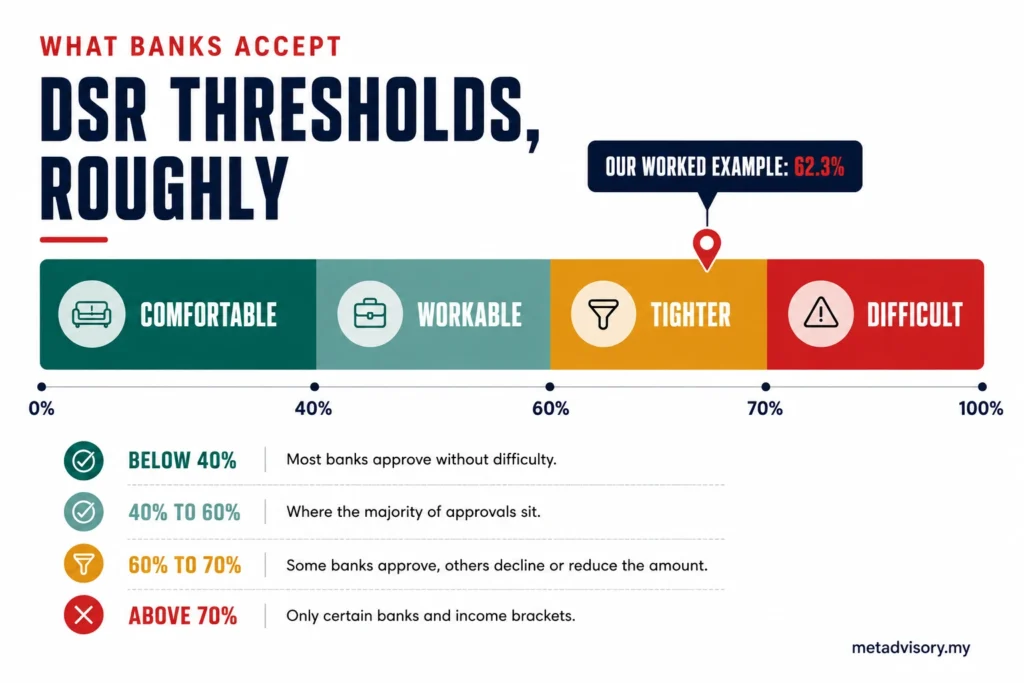
At 62.3%, this application sits in a workable range for several Malaysian banks — but not all of them. Some would approve it comfortably. Others cap at 60% for this income bracket and would decline, or approve a smaller amount.
The same applicant, same figures, can be approved by one bank and rejected by another. This is why which bank you approach matters as much as your profile.
What Counts as a Commitment
This is where most self-calculations go wrong. Banks count more than you might expect.
Credit cards are calculated on the limit, not the balance
This surprises almost everyone. Banks typically count 5% of your total credit card limit as a monthly commitment — regardless of whether you owe anything on it. A RM20,000 limit you never use still adds RM1,000 to your monthly commitments in the bank's eyes.
PTPTN counts
Student loan repayments are a commitment like any other, and appear on your CCRIS record.
Loans you guaranteed for someone else can count
If you stood as guarantor on a family member's facility, some banks include a portion of it in your commitments.
Everything on your CCRIS record
Personal loans, hire purchase, overdrafts, other mortgages, and buy-now-pay-later facilities where reported. If it appears on CCRIS, assume it counts.
What generally does not count
Rent, utilities, insurance premiums, school fees and living expenses are not debt commitments and do not enter the DSR calculation — though banks assess affordability more broadly.
What DSR Will Banks Accept?
There is no single national threshold, which is the most misunderstood part of this topic. Acceptable DSR varies by bank, by income bracket, and by the applicant's overall profile.
As a general guide, Malaysian banks work within a range of roughly 50% to 80%. Higher income earners are typically allowed a higher DSR, on the reasoning that someone earning RM20,000 a month has more disposable income remaining at 70% than someone earning RM4,000.
What to Do if Your DSR Is Too High
A high DSR is not necessarily the end of the application. It usually means something needs adjusting first. In rough order of effectiveness:
Reduce your credit card limits
Because banks count 5% of the limit rather than the balance, cutting an unused RM20,000 limit to RM10,000 removes RM500 from your monthly commitments immediately. In our worked example, that alone brings the DSR from 62.3% down to 54.6%. It is the fastest lever available and costs nothing.
Settle a small facility entirely
Clearing the car loan in the example above drops the DSR from 62.3% to 49.2% — a decisive improvement. If you have savings and a nearly-finished facility, settling it before applying can be worth more than keeping the cash.
Extend the loan tenure
A longer tenure means a lower monthly instalment, which lowers your DSR. The trade-off is more interest paid across the life of the loan.
Apply jointly
Adding a co-borrower brings their income into the calculation — though it brings their commitments too, so it only helps if their own DSR is healthy.
Wait for a commitment to end
If your car loan finishes in four months, waiting may be the simplest solution available.
Three Mistakes to Avoid
- Using gross income instead of net. Banks calculate on net income after statutory deductions.
- Forgetting a dormant facility. An old credit card or an overdraft you never use still appears on CCRIS and still counts.
- Assuming every bank calculates identically. They do not — different banks treat variable income, bonuses and guarantor obligations differently.
Why This Matters Before You Apply, Not After
Every home loan application appears on your CCRIS record, including the rejections. Several rejections in a short period make the next application harder, because subsequent banks can see that others declined you.
Calculating your DSR first tells you whether to apply now or spend three months strengthening your position.
Frequently Asked Questions
What is a good DSR for a home loan in Malaysia?
Below 40% is comfortable and approved without difficulty by most banks. Between 40% and 60% is where the majority of approvals sit. Above 70% becomes difficult, though certain banks and higher income brackets can still qualify.
Does my credit card limit affect my DSR?
Yes, and this catches most people out. Banks typically count 5% of your total credit card limit as a monthly commitment, regardless of your actual balance. Reducing unused limits is the quickest way to improve your DSR.
Is DSR calculated on gross or net income?
Net income, after statutory deductions such as EPF, SOCSO and tax.
Does PTPTN count towards my DSR?
Yes. PTPTN repayments are treated as a debt commitment and appear on your CCRIS record.
Can I still get a home loan with a high DSR?
Possibly. Acceptable DSR varies significantly between banks. This is precisely why matching your profile to the right bank matters — the same application can be declined by one lender and approved by another.
How can I lower my DSR before applying?
The fastest options are reducing unused credit card limits and settling small facilities close to completion. Applying jointly with someone whose own DSR is healthy can also help.
Not Sure Where You Stand?
Send us your income and commitments. We will calculate your DSR properly and tell you honestly which banks are realistic for your profile — including whether it is worth applying now or strengthening your position first. Free assessment, no obligation.