
Say "deductible" to most Malaysians and the reaction is the same: "Wah, then I pay myself? Then what's the point of insurance?"
It sounds logical. But for many working adults, a deductible is one of the smartest ways to keep a medical card affordable for the long run — especially now that premiums are rising every year.
Here's what a deductible really does, when it works in your favour, and when it doesn't.
What is a deductible, in plain terms?
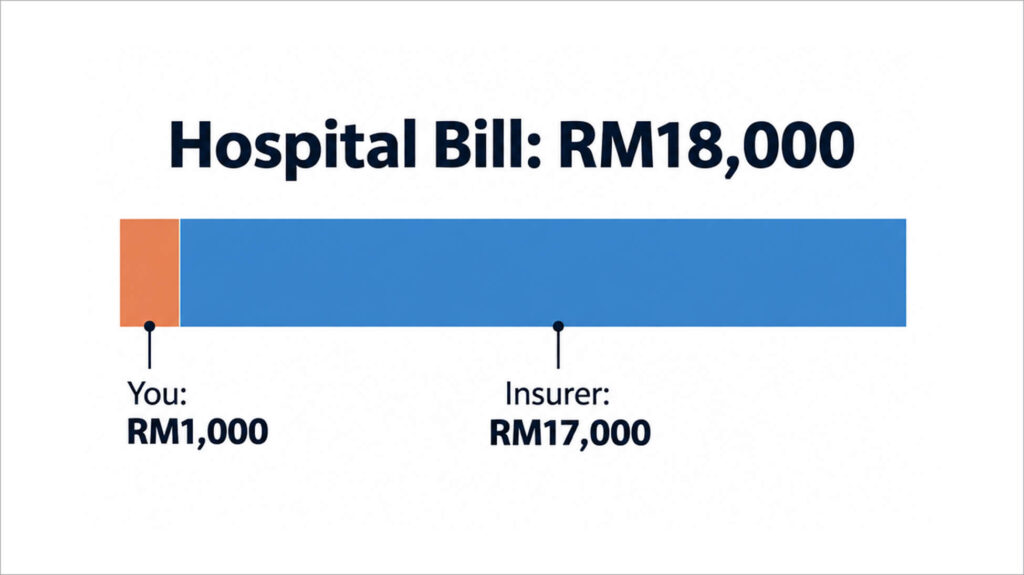
A deductible is the fixed amount you pay first on a hospital bill before your insurer pays the rest.
Example: You have a RM1,000 deductible and your hospital bill is RM18,000.
- You pay: RM1,000
- Your insurer pays: RM17,000
It's different from co-payment (co-insurance), where you pay a percentage of every bill — for example 5% or 10%, usually up to a cap.
| Deductible | Co-payment | |
|---|---|---|
| How it works | Fixed amount first | % of the bill |
| On an RM18,000 bill | RM1,000 (fixed) | RM900 at 5% |
| On an RM80,000 bill | RM1,000 (still fixed) | RM4,000 at 5% (unless capped) |
| Predictability | High — you know your maximum | Depends on the cap |
The myth: "Deductible = less protection"
The truth: a deductible doesn't reduce your coverage. It shares the first part of the bill.
Your annual limit, room and board, surgical benefits and cancer treatment cover stay the same. The only difference is who pays the first RM500, RM1,000 or RM3,000.
What you get back is a lower premium — every single year, whether you claim or not.
Why this matters more in 2024–2027
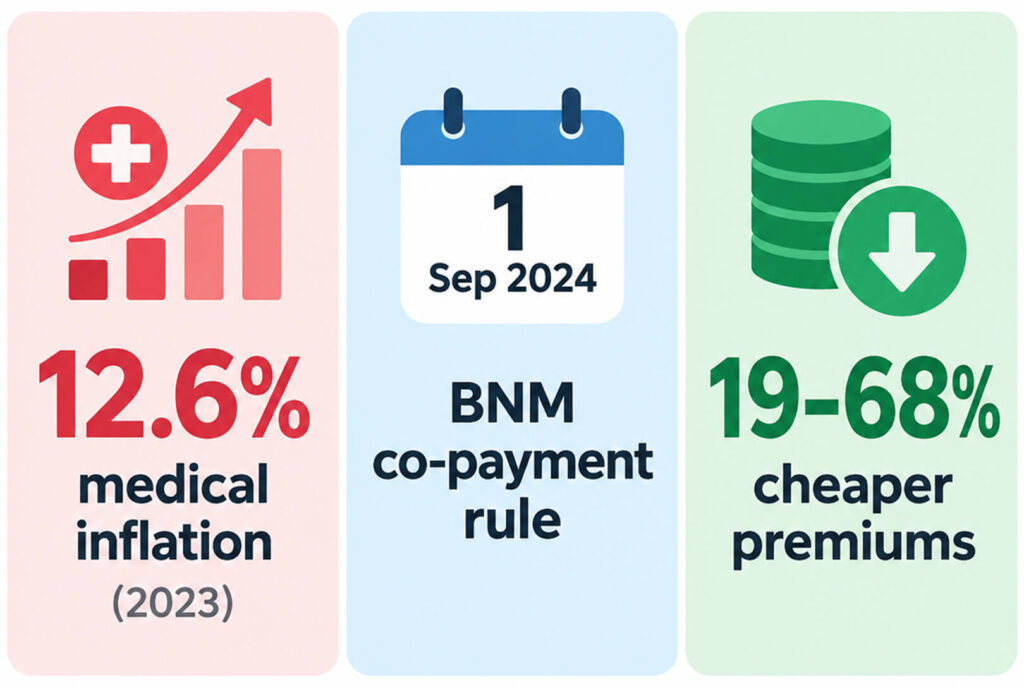
- Medical inflation is high. Malaysia's medical cost inflation rose from around 10% in 2022 to about 12.6% in 2023. That flows straight into medical card repricing.
- Bank Negara now requires co-payment options. Since 1 September 2024, all insurers and takaful operators must offer at least one co-payment option on new medical plans — either a minimum 5% co-insurance or a RM500 deductible.
- The savings are real. BNM has observed co-payment plans priced 19% to 68% cheaper than comparable full-coverage plans, depending on the level chosen.
- A standardised base plan is coming. BNM's Base MHIT plan began its pilot phase in mid-2026, with a full launch targeted for 2027, and will also use tiered co-payments. Sharing the first part of the bill is becoming the norm, not the exception.
A real-life comparison
Illustrative figures only. Actual premiums depend on age, plan and insurer.
Aaron, 35, non-smoker, office job in KL.
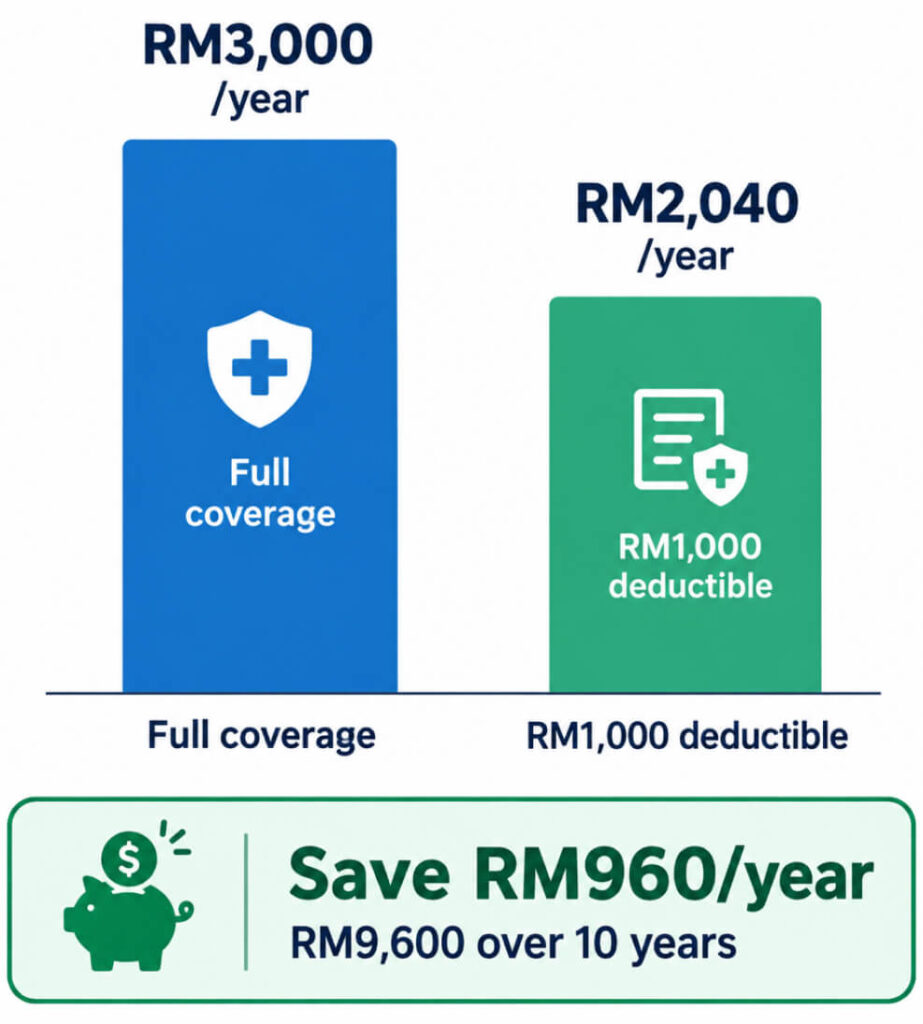
| Full coverage card | Card with RM1,000 deductible | |
|---|---|---|
| Monthly premium | RM250 | RM170 |
| Yearly premium | RM3,000 | RM2,040 |
| Saved per year | — | RM960 |
| Saved over 10 years* | — | RM9,600 |
*Before future repricing. When premiums go up, the gap usually grows too.
The math: the RM960 yearly saving is close to the RM1,000 deductible itself, so Aaron's break-even point is roughly one hospitalisation a year — at that point the saved premium and the deductible he'd pay are nearly a wash. He comes out ahead only if he's admitted less than once a year on average, which describes most healthy adults in their 30s and 40s. If he's admitted once in 10 years, he pays RM1,000 and keeps about RM8,600 in savings.
The part most people miss: your company insurance can cover the deductible
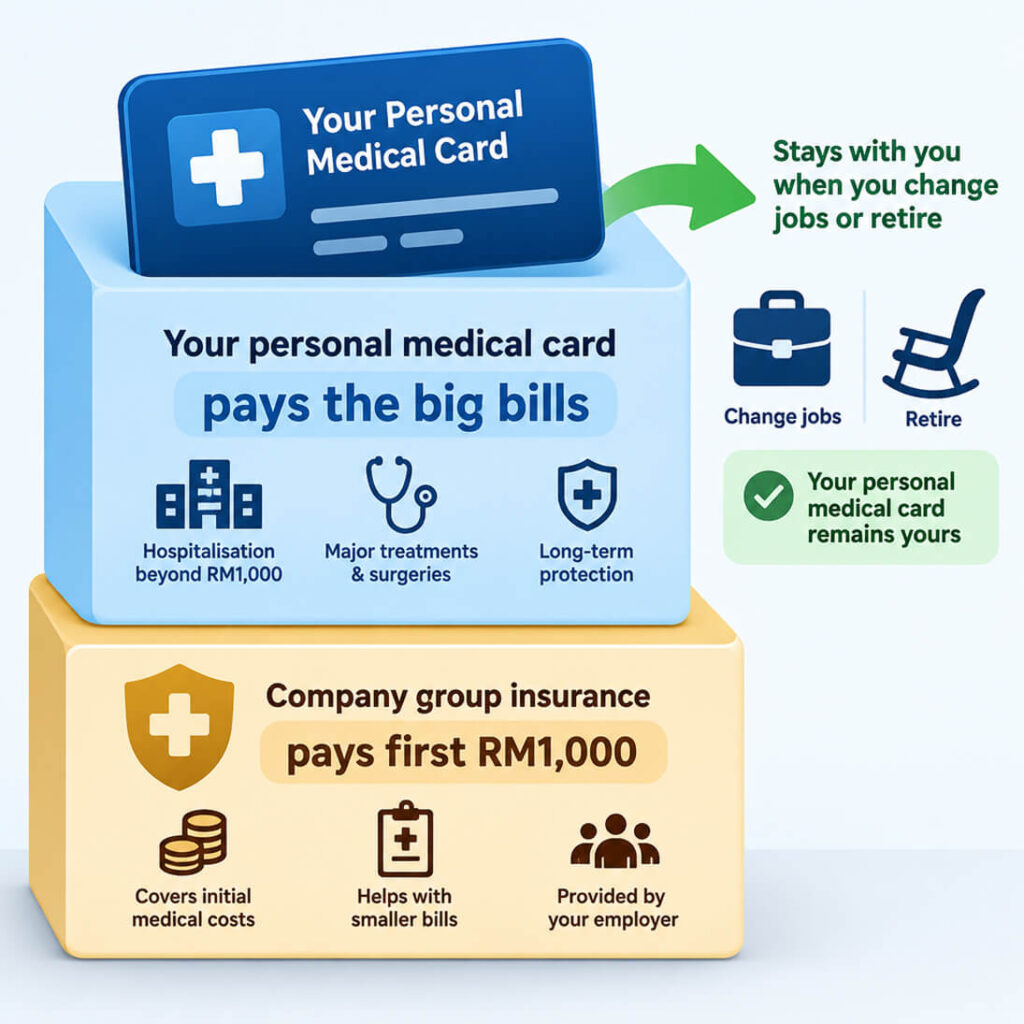
Many salaried Malaysians already have group hospitalisation cover from their employer. On many personal plans, the deductible can be settled by another policy, such as your company's group insurance.
So in practice:
- While you're employed: your company plan covers the first RM1,000. Your personal card covers the big bills.
- When you change jobs, retire or start a business: your personal card is still there, and you've already locked it in at a lower cost.
Check your policy terms — not every plan allows this.
Who a deductible works well for
- Working adults with company group medical cover
- Healthy individuals who rarely get hospitalised
- People with an emergency fund of at least RM3,000–RM5,000
- Families who want to keep premiums sustainable into their 50s and 60s
- Anyone whose current premium is starting to feel heavy
Who should think twice
- People with frequent admissions or ongoing conditions
- Retirees on a fixed income with no savings buffer
- Anyone who would struggle to pay RM1,000 at short notice
Also note: under BNM's rules, co-payment generally doesn't apply to emergency treatment (including accidents), follow-up outpatient care for critical illnesses such as cancer or dialysis, or treatment at government hospitals. Always confirm the exact exclusions with your insurer.
What to avoid
1. The "all-in" package with zero deductible. It feels safest, but you pay for that comfort every month, whether you're admitted or not. For most healthy adults, you end up paying the insurer more in extra premiums than the deductible would ever have cost you.
2. "Upgrading" to a huge annual limit you'll never use. RM20 million or "Unlimited" sounds impressive. But the extra premium adds up year after year, and gets heavier with every repricing. Ask a simpler question: what would a serious hospital stay realistically cost me, at the hospital I'd actually go to? Then cover that well, with a reasonable buffer.
3. Buying on fear, not facts. Bigger isn't automatically better. The right plan is the one you can afford to keep until your 70s and 80s.
Do your own due diligence. Before you buy or upgrade, check:
- Room & board: does the daily rate match the hospitals near you?
- Annual limit: is it realistic for a major surgery or a year of cancer treatment, or is it just a big number?
- Existing cover: what does your company's group insurance already pay for?
- Future premiums: ask for the projected premium at age 55 and 65, not just today's price
- Deductible options: ask for the same plan quoted at RM0, RM1,000 and RM3,000, side by side
Sit down with your advisor and go through the numbers together. The best plan covers what's necessary, not everything that's available.

The real risk isn't the deductible. It's dropping your cover.
Every year, some Malaysians cancel their medical card because the premium became too much — often in their 50s, right when they need it most, and when re-applying gets harder.
A well-chosen deductible can be the difference between keeping your cover for life and letting it lapse at the worst time.

Frequently asked questions
Is a deductible the same as co-payment?
No. A deductible is a fixed amount you pay first. Co-payment is a percentage of the bill, usually with a cap.
Can I switch my existing medical card to a deductible plan?
Some insurers allow this; others require a new policy with fresh underwriting. Get advice before cancelling anything — you could lose coverage for existing conditions.
What deductible amount is common in Malaysia?
RM500, RM1,000 and RM2,500 are common options. The higher the deductible, the lower the premium.
Does the deductible apply to every claim?
Usually per admission or per policy year, depending on the plan. Check your policy wording.
Is a deductible plan worth it if I have no company insurance?
It can be, if you're healthy and have savings to cover it. Your premium saving each year can be set aside to fund the deductible.
Not sure which setup suits you?
Our senior authorised advisors can review your current medical card, your company coverage and your budget — and show you side-by-side what a deductible would change. No consultation fees.
Disclaimer: This article is for general information only and does not constitute advice for your specific situation. Premium figures are illustrative. Coverage, deductible terms and exclusions vary by insurer and plan; please refer to the product disclosure sheet and policy contract. MET Advisory Malaysia Sdn Bhd distributes insurance products under Bank Negara Malaysia jurisdiction.