
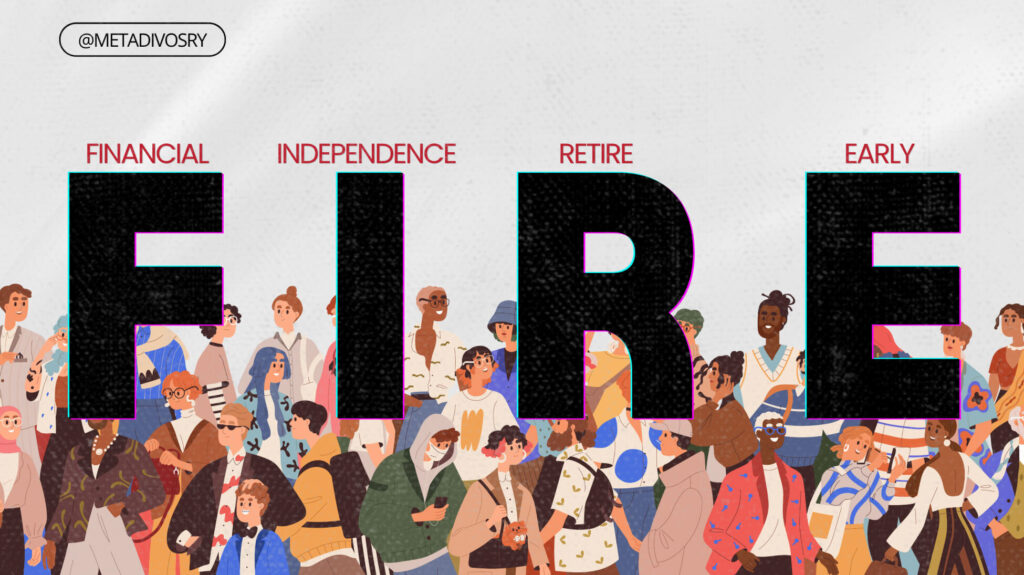
You've probably seen the acronym floating around — FIRE. Financial Independence, Retire Early. Stories of people quitting their jobs at 35, living off investments, and never touching a 9-to-5 again.
It's an appealing idea. But for most Malaysians, the version of FIRE that goes viral online — often built around US salaries, US stock returns, and US cost of living — doesn't translate directly here. That doesn't mean the underlying principle is useless. It just means it needs to be recalculated for a Malaysian context, with Malaysian numbers.
Here's a grounded look at what FIRE actually means, how it's typically calculated, and where the popular version of the idea tends to fall short.
What Does FIRE Actually Mean?
At its core, FIRE isn't really about "never working again." It's about reaching a point where your investments and savings generate enough passive income to cover your living expenses — meaning work becomes optional, not necessary.
Once you hit that number, you have a choice: retire fully, downshift to part-time or lower-stress work, or keep working simply because you want to, not because you have to. This distinction matters more than the "retire early" branding suggests.

How Is the FIRE Number Calculated?
The most common method is the 25x rule, based on the idea that you can safely withdraw about 4% of your investment portfolio each year without running out of money over a long retirement.
The formula:
FIRE Number = Annual Expenses × 25
For example, if your household spends RM60,000 a year, your FIRE number would be:
RM60,000 × 25 = RM1,500,000
Once your investable assets reach that amount, the theory goes, a 4% annual withdrawal (RM60,000) should sustainably cover your expenses without depleting the principal, assuming reasonable long-term investment returns.
Why the "4% Rule" Needs a Malaysian Adjustment
The 4% withdrawal rule was originally based on historical US stock market data (the "Trinity Study"), covering decades of US equity and bond returns. It wasn't built around Malaysian markets, the ringgit, or local inflation patterns.
A few things worth factoring in if you're calculating your own FIRE number in Malaysia:
- Currency and inflation. Malaysia's inflation rate and the ringgit's long-term stability differ from the US dollar. A withdrawal rate calibrated to US markets may not hold up the same way locally, especially over a 30–40 year retirement horizon.
- Healthcare costs. Without employer-provided medical coverage after leaving full-time work, healthcare becomes a significant, often underestimated expense — particularly as you age and if government-subsidised healthcare access changes over time.
- EPF and retirement structures. Malaysia's EPF system already provides a form of forced retirement savings, but full access is still generally locked until age 60 — contributions made after age 55 go into a separate account that can't be touched until then. From January 2026, EPF has also moved to a new Retirement Income Adequacy framework, assessing readiness against a savings target at age 60 (phasing in at RM290,000 in 2026, rising to RM390,000 by 2028) rather than the older RM240,000-by-55 benchmark, and framing adequacy around roughly 20 years of monthly drawdown from age 60 rather than a single lump sum. A FIRE strategy that assumes early, unrestricted access to all your capital needs to account for what's actually liquid before then.
- Where you actually retire. Cost of living varies enormously between, say, Kuala Lumpur and a smaller town. FIRE numbers calculated for KL-level expenses may be significantly overstated for those planning to relocate.
What Most FIRE Guides Leave Out
Beyond the math, there are a few practical gaps that rarely get airtime in FIRE content — but matter a great deal in reality.
Sequence of returns risk. If a market downturn hits in the first few years after you stop working, withdrawing from a shrinking portfolio can permanently damage your long-term sustainability, even if the market recovers later. This risk is far more dangerous early in retirement than later.
What happens to your protection needs. Life insurance, medical coverage, and disability protection are often tied to employment benefits. Once you "retire early," those gaps need to be filled independently — and at an older age, premiums are typically higher than if arranged earlier.
Legacy and estate considerations. If part of your motivation for FIRE is leaving something behind for your family, your investment strategy and your estate planning need to work together — otherwise assets meant for your dependents can get tied up, taxed, or delayed in ways that undermine the original goal.
The emotional side. Many people who reach financial independence early find the adjustment harder than expected — work often provides structure and identity beyond just income. This isn't a reason to avoid FIRE, but it's worth planning for deliberately rather than assuming it resolves itself.
A Generational Shift in How FIRE Is Approached
It's also worth noting that FIRE looks different depending on which generation is pursuing it.
Millennials are largely approaching FIRE from the other end of the timeline. Many have already spent close to two decades building a career, climbing the corporate ladder, and accumulating savings the traditional way — steady employment, EPF contributions, and gradual investing. For this group, FIRE tends to be less about escaping work early and more about reaching a point where continuing to work becomes a choice rather than a necessity, after years of groundwork already laid.

Gen Z, on the other hand, is entering a noticeably different job market. In several major economies, hiring has recently shifted toward what's often described as a "low-hire, low-fire" environment — employers more cautious about expanding headcount, but also slower to lay off existing staff compared to previous cycles. The picture for young, entry-level workers specifically has been mixed rather than uniformly stable: some data shows elevated entry-level unemployment even within this pattern, as employers post more roles without hiring proportionally more people. Whether this exact dynamic plays out the same way in Malaysia isn't something to assume — but the broader caution around aggressive early-career job-hopping for rapid salary growth is a reasonable planning assumption either way.
This shift changes how FIRE needs to be approached for younger workers. Rather than relying on the rapid income jumps that fuelled many viral early-FIRE stories, a more realistic path for Gen Z leans on consistent saving habits started early, disciplined investing over a longer runway, and treating career stability as an asset to build around — rather than assuming constant upward salary mobility.
In both cases, the core FIRE principle holds: know your number, understand what's actually liquid and when, and build the plan around your real circumstances — not the generation or country the original strategy was built for.
A More Realistic Way to Think About FIRE in Malaysia
Rather than chasing a viral number pulled from a US blog, a more useful approach is to calculate your own FIRE number based on:
- Your actual current and projected annual expenses (not a rough guess)
- A withdrawal rate adjusted for Malaysian market conditions and inflation, rather than assuming 4% applies directly
- What's genuinely liquid and accessible at different ages, factoring in EPF and other locked structures
- Protection coverage that replaces what your employer currently provides, sized for the years before and after your target retirement date
- How your estate and legacy goals fit into the plan, not as an afterthought
FIRE, done properly, isn't about hitting an arbitrary number as fast as possible. It's a financial independence plan — and like any plan, it holds up better when it's built around your real numbers, not someone else's spreadsheet from a different country.
This article is for general informational purposes only and does not constitute financial or investment advice. Retirement and investment outcomes depend on individual circumstances and market conditions. Speak to a licensed advisor before making retirement planning decisions.
Want to calculate your own FIRE number properly?
We can help you build a withdrawal strategy adjusted for Malaysian conditions, factoring in EPF timing, protection gaps, and your actual numbers. WhatsApp us or get in touch for a personalised assessment.